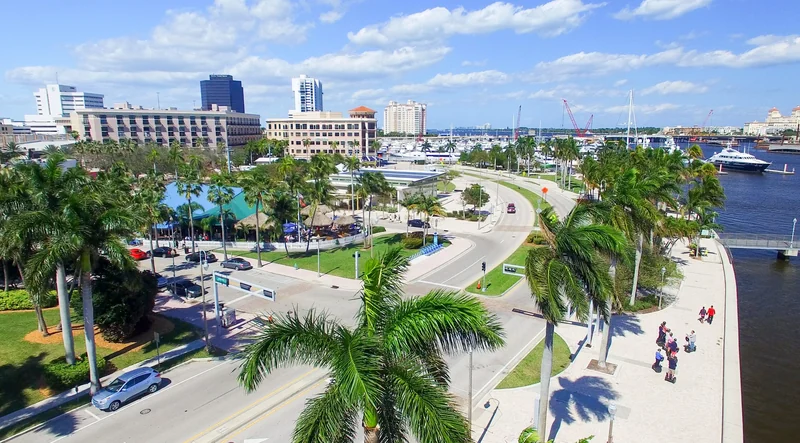





On a financed purchase in Palm Beach County FL, the loan brings its own government charges: mortgage stamps of 35 cents per $100 borrowed and a 2-mill intangible tax, plus lender fees, recording fees and prepaid insurance and taxes. Deed stamps of 70 cents per $100 of price and the owner's title policy have no fixed payer in the law. Your purchase contract decides, so read that paragraph before you sign.
- 70 cents per $100Deed Documentary Stamp Tax
- 35 cents per $100Mortgage Documentary Stamp Tax
- 2 millsIntangible Tax On A New Mortgage
- 3 business daysClosing Disclosure Before Closing
Closing costs are not one fee. They are a stack of separate charges, and each one has its own rule.
Some are set by Florida law. Some are set by your contract. Some come from your lender, and some from your insurance company.
I have lived and worked in downtown West Palm Beach for over two decades.
This article goes line by line through a Palm Beach County closing statement. It covers who sets each amount and what decides who pays it.

Who Decides Who Pays Each Closing Cost?
Three things decide it: state law, your purchase contract and your lender. The contract is the one you negotiate.
The federal Consumer Financial Protection Bureau, or CFPB, puts the starting point plainly. When you are buying a home you generally pay all of the costs associated with that transaction. However, depending on the contract or state law, the seller may end up paying for some of these costs.1
Florida's tax law shows how this works. For documentary stamp tax, all parties to the document are liable for the tax regardless of which party agrees to pay the tax.2
In plain words, the state wants its tax and doesn't care who wrote the check. Who actually pays is a deal point between you and the seller.
The Costs At A Glance
| Cost | Who sets the amount | What decides who pays |
|---|---|---|
| Deed documentary stamps | Florida law | Your contract |
| Mortgage stamps and intangible tax | Florida law | Charged on your loan |
| Owner's title insurance premium | State rate rule | Your contract |
| Title search and closing services fees | Each title company | Your contract and Closing Disclosure |
| Recording fees | Florida law | Your contract and Closing Disclosure |
| Property tax split | The tax bill | Your contract |
| Estoppel certificate fee | The association, up to a state cap | Your contract |
The rest of this article takes these one at a time.
Seller Credits And Lender Credits
A credit can lower the cash you bring to closing. It is rarely free.
The CFPB says you can negotiate a seller credit toward closing costs. But the seller will usually require you to pay a higher price for the home in order to cover the costs of this credit.1
A lender credit works the same way. Typically, the lender will either increase your loan amount to cover these costs, or charge you a higher interest rate in exchange for the credit.1
A credit can still be the right trade. Just know what you are giving for it.
What Are Florida's Documentary Stamp And Intangible Taxes?
These are the government charges on the deed and the loan. The rates are fixed by law, so you can work them out before you make an offer.
The Florida Department of Revenue calls documentary stamp tax an excise tax imposed on certain documents executed, delivered, or recorded in Florida. Tax is paid to the county clerk of court or a recording official when the document is recorded.2
Deed Stamps: 70 Cents Per $100 Of Price
The deed stamps are figured on the price.
In Palm Beach County, the rate is 70 cents per $100 or portion thereof of the total consideration.2
"Portion thereof" means any part of $100 counts as a full $100. Using my math, a price of $500,050 counts as 5,001 units of $100.
The Department of Revenue gives its own example. A $180,000 purchase is 1,800 taxable units, and 1,800 times $0.70 is $1,260.2
An existing mortgage counts too. If the property being transferred has a mortgage on it, the balance of the mortgage at the time of transfer is consideration for the transfer.2
That matters if you ever take over a seller's loan. The loan balance is part of the price for this tax.
Who pays the deed stamps is set by your contract. Read the closing cost paragraph before you sign so there is no surprise on the statement.
Mortgage Stamps: 35 Cents Per $100 Borrowed
If you finance, your mortgage carries its own stamp tax.
On recorded mortgages, the rate is 35 cents per $100, or portion thereof, of the amount secured. There is no cap on the amount of tax due.2
You may see a cap of $2,450 mentioned for promissory notes.3 Florida's statute answers that. When there is both a mortgage and a note, the tax shall be paid on the mortgage at the time of recordation. The note gets a notation that the tax was paid.3
So on a typical purchase loan, the tax is paid once, on the full loan amount, when the mortgage is recorded.
The Intangible Tax: 2 Mills On The Loan
Florida also charges a one-time nonrecurring intangible tax on a new mortgage.4
The rate is 2 mills. That means the loan amount times 0.002, or $2 for every $1,000 borrowed.5
The Department of Revenue says the lender is the taxpayer liable for the nonrecurring intangible tax, but the lender may pass the amount of the tax to the borrower. The tax is never figured on more than the fair market value of the Florida property securing the loan.5
The Math At Three Price Points
Here is my math using the state rates, assuming 20% down. Your own numbers will depend on your price and loan.
| Price and loan | Deed stamps | Mortgage stamps | Intangible tax |
|---|---|---|---|
| $500,000 price, $400,000 loan | $3,500 | $1,400 | $800 |
| $1,000,000 price, $800,000 loan | $7,000 | $2,800 | $1,600 |
| $2,000,000 price, $1,600,000 loan | $14,000 | $5,600 | $3,200 |
The mortgage stamps and the intangible tax are charges on a mortgage. If you pay cash and record no mortgage, those two lines don't apply to you.
On your Closing Disclosure, these appear under Taxes and Other Government Fees. The CFPB describes these as costs associated with transferring the property to you and registering your mortgage with the county records office.6
This is not legal or tax advice. Check with a Florida attorney or tax professional.

How Much Is Title Insurance In Florida, And Who Pays For It?
Florida sets title insurance premiums by rule, so the premium itself is the same no matter which title insurer you use. What varies is the title company's other service fees, and who pays is up to your contract.
Why The Premium Is Set By The State
Florida law says the state must adopt a rule specifying the premium title insurers charge for each type of policy.7
Florida's Department of Financial Services, or DFS, explains it in its title insurance overview. Title insurance rates are established by rule 69O-186.003, Florida Administrative Code.8 You can also read the rule page itself.
DFS gives the owner's policy rates this way:
- The first $100,000 of coverage: $5.75 per thousand8
- From there up to $1 million: $5.00 per thousand8
- Minimum premium: $100.008
DFS puts it plainly. Anyone issuing a $100,000 owner's title insurance policy in the state of Florida should be charging the exact same base premium rate of $575.8
DFS also says an owner's policy should be issued for the full insurable value of the premises, which is the sale price of the property.8
What The Owner's Premium Comes To
Here is my math from the DFS rates, for the base premium only:
| Price | Owner's policy base premium |
|---|---|
| $500,000 | $2,575 |
| $1,000,000 | $5,075 |
The DFS page gives rates only up to $1 million of coverage. For a purchase above $1 million, ask your title agent to show you the rule's figure for your price.
Ask the title agent, too, whether your lender wants any endorsements and what they add.
What Owner's And Lender's Policies Protect
A purchase with a loan can involve two policies.
The lender's policy. The CFPB says most lenders require you to purchase a lender's title insurance policy.9 Lender's title insurance does not protect your investment in the home (your equity).10
The owner's policy. Owner's title insurance protects the homeowner if someone sues and says they have a claim against the home from before the homeowner purchased it.9
The CFPB gives examples. Legal claims could come from a previous owner's failure to pay taxes, or from contractors who say they were not paid for work done on the home before you purchased it.9
For the owner's policy, the CFPB's wording is a choice. You may want to buy an owner's title insurance policy, which can help protect your financial investment in the home.9
DFS notes one more difference. There is no expiration date on the owner's policy, while the lender's policy lasts until the loan is paid in full.8
The Simultaneous Issue Rate
When both policies are issued at the same time, Florida gives the lender's policy a special rate.
DFS says simultaneous issue rates apply when an owner's policy and a lender's policy are issued at the same time, within the same transaction on the same insurer. The owner's policy is charged the regular owner's rates.8
The lender's rate will be a minimum $25 for an amount of coverage not to exceed the limit of the owner's policy. Lender coverage above the owner's coverage amount is figured at the full premium rates in the rule.8
The CFPB makes a related point. If you buy an owner's policy, the total cost is usually lower when one provider issues both policies.9
Who Pays For The Owner's Policy
Who pays for the owner's policy is set by your purchase contract.1 Read that paragraph before you sign, and ask about it if it isn't clear.
It matters for more than the bill. DFS says the person paying the title insurance premium gets the first choice of closing/title agent. However, the lender must approve of the closing/title agent chosen.8
Whoever pays, the premium comes from the same state rate table.
The Reissue Rate Can Save Money
If the seller owns a title policy on the home, ask about the reissue rate.
DFS says that if a prior owner's policy exists, reissue rates should be charged. The reissue rate is $3.30 per thousand for the first $100,000, then $3.00 per thousand up to $1 million of coverage.8
Here's an example. Not a real sale. If the reissue rate applies to a full $500,000 of coverage, the premium by my math is $1,530 instead of $2,575.
The rule sets the conditions for the reissue rate, so ask the title agent early whether the seller's policy qualifies. Ask the listing agent, too, whether the seller has a copy of their owner's policy.
A Discount On Some New Homes
New construction has its own line in the rule. DFS says the rule specifies a new home purchase discount, along with reissue rates and other situations.8
If you are buying from a builder, ask the title agent whether the discount applies to your purchase. My article on buying pre-construction covers the rest of a new construction purchase.
What You Can Compare
The premium is fixed. Some of the work around it is not.
Florida law says a title insurer must first make a determination of insurability. Until then, it may not issue a commitment, endorsement or policy.11
That examination is part of the premium, not an extra charge. DFS says the examination of records to judge insurability is part of the primary title services. Those are a component of the premium, and a separate fee is not charged to the consumer.12
The title search and the closing work are different. DFS says closing services, such as preparing the documents, conducting the closing and disbursing the funds, should be recorded as closing costs on the Closing Disclosure form. It adds that the title search is defined separately.12
So when you compare title companies, compare the title search and closing services fees. If a statement shows a separate charge for examining the title, ask about it.
DFS also describes how a title agency records a rebate of the agent's share of the premium on the Closing Disclosure. The premium itself is still the promulgated rate.12
The CFPB says you can usually shop for your title insurance provider separately from your mortgage.9
Check with a Florida attorney or tax professional.
What Do Recording Fees, Surveys And Appraisals Add?
These are smaller lines on the statement. Recording fees follow a state schedule. For surveys and appraisals, ask for quotes.
Recording Fees
The Clerk records your deed and your mortgage in the county's official records. Florida law sets the per-page charges in section 28.24.

For an instrument not more than 14 inches by 8 1/2 inches, the statute lists three charges:13
- Recording fee: $5.00 for the first page and $4.00 for each additional page13
- Records modernization charge: $1.00 for the first page and $0.50 for each additional page13
- Additional service charge: $4 per page13
Adding those page charges together, by my math, comes to $10 for the first page and $8.50 for each additional page.
Here's an example. The page counts are made up. In page charges alone, a 3-page deed would come to $27, and a 20-page mortgage would come to $171.50.
Those are page charges only. The same statute adds $1.00 per additional name for indexing an instrument that contains more than four names.13
Your real documents set the page count. Ask your title agent for the full recording figure on your file.
The Survey
A survey shows where the lot lines are and what sits on or across them.
Florida's surveying standards are in Rule 5J-17.052.14 The copy posted by the Florida Department of Agriculture and Consumer Services says evidence of boundary lines, such as fences, walls, buildings, monuments or otherwise, shall be shown upon the map. It also says all apparent physical use onto or from adjoining property must be indicated, with the extent of such use shown or noted upon the map.14
That is how a buyer finds out that a neighbor's fence, driveway or shed crosses the line. Recorded easements shown on plats must also be located and shown.14
Ask your lender and title agent whether your purchase needs one, and get a quote early so it is done well before closing.
The Appraisal
If you finance, your lender uses an appraisal to decide how much the home is worth.15 The CFPB lists appraisal fees among the common closing fees.1
The CFPB says the appraisal is conducted by an independent, professional appraiser. You have a right to receive a copy.15
Read it when it arrives. An appraisal that comes in higher or lower than expected is one of the changes that lets a lender revise closing costs, as the lender section below explains.
How Are Property Taxes Split At Closing In Palm Beach County?
Florida property tax bills come at the end of the year they cover, so the closing splits that year's bill between you and the seller. Your contract sets how the split is figured.
Why Florida Taxes Get Split
Under Florida law, all taxes shall be due and payable on November 1 of each year or as soon thereafter as the certified tax roll is received by the tax collector. Taxes shall become delinquent on April 1 following the year in which they are assessed.16
That means the tax bill for a year arrives late in that same year. If you close in June, the seller has owned the home for part of a year whose bill has not come yet.
Florida also gives early payment discounts: 4 percent in November, 3 percent in December, 2 percent in January and 1 percent in February.17
The Palm Beach County Tax Collector's website is running a countdown to receive the 4% discount on 2026 property taxes. If you need in-person service there, a reservation is required.18
How It Shows Up On Your Closing Disclosure
The CFPB's Closing Disclosure explainer shows two lines for this.
Adjustments for Items Unpaid by Seller. The CFPB describes these as prior taxes and other fees owed by the seller that you will pay in the future. The seller is reimbursing you now to cover these expenses.6
Adjustments for Items Paid by Seller in Advance. These are costs that have been prepaid by the seller that you are now reimbursing the seller for.6 A closing in December, after the seller has paid the year's bill, is one time this can come up.
How the split is figured, such as which bill is used and whether the discount is counted, is set by your contract and handled by your closing agent. Ask them to walk you through the numbers.
The Seller's Bill Is Not Your Bill
Whatever bill the split uses, your own future bill can be very different.
If the seller had a homestead exemption, their assessed value may have grown by no more than 3% a year or the change in the Consumer Price Index, whichever is lower.19 Florida law resets the value to just value as of January 1 of the year following a change of ownership.20
If you make the home your permanent residence, you can file for your own homestead exemption.19 You must be eligible as of January 1 and apply by March 1 of the year the benefit applies.19
Florida's homestead amendment, Amendment 3, passed on 11-03-2026. It takes effect on 01-01-2027.21
To estimate your own bill, the Property Appraiser's FAQ explains that at the bottom of the property detail page there is a "Property Tax Calculator" button. Enter your purchase price and whether you plan to homestead the property, and it gives you an estimate.22
My article on property taxes and homestead after you buy walks through all of this in detail, including what Amendment 3 changes.
Check with a Florida attorney or tax professional.
The Escrow Deposit At Closing
If your lender sets up an escrow account, part of your future taxes and insurance gets paid in at closing.
The CFPB says many lenders require that you pay your taxes and insurance using escrow, so they can make sure that the bill gets paid. Your property taxes and insurance premiums can change from year to year, and your escrow payment changes with them.23
There is a limit on the deposit for a loan covered by the federal Real Estate Settlement Procedures Act. The lender can require only enough to keep the escrow account from ever going negative, plus two months' worth of estimated disbursements as a cushion.24
After closing, every month, your mortgage servicer can require you to pay up to one-twelfth of the total annual escrow payments it reasonably expects to pay out.24

What Are HOA And Condo Estoppel Fees?
An estoppel certificate is the association's signed statement of what is owed on the home. Florida caps what an association can charge for it, and your contract decides who pays.
Why The Estoppel Certificate Matters To You
Florida law makes a buyer share the seller's unpaid association debts.
For condos, a unit owner is jointly and severally liable with the previous owner for all unpaid assessments that came due up to the time of transfer of title.25 For homeowners' associations, a parcel owner is jointly and severally liable with the previous parcel owner for all unpaid assessments that came due up to the time of transfer of title.26
In plain words, if the seller is behind, the association can come to you. The estoppel certificate is how the closing catches it.
It also protects you. If you rely on the certificate in good faith, the association waives the right to collect more than the certificate shows.27
What It Shows
The certificate lists what is owed and what is coming due. Among other things, Florida's HOA statute requires it to answer this question: Is there a capital contribution fee, resale fee, transfer fee, or other fee due?27
The estoppel certificate, and the association's documents, tell you whether a fee like that is due on your purchase.
Timing
The duty starts with the right request. Florida law says the association must issue the certificate within 10 business days after receiving a written or electronic request from the owner or the owner's designee, or the mortgage lender or the lender's designee.27
If the association gets a request like that and fails to deliver the estoppel certificate within 10 business days, a fee may not be charged for the preparation and delivery of that estoppel certificate.27
Ask your title agent who requested it and when, so you know whether the clock is running.
An estoppel certificate that is hand delivered or sent by electronic means has a 30-day effective period. An estoppel certificate that is sent by regular mail has a 35-day effective period.27
If the association learns of a mistake or new information within the effective period, it can deliver an amended certificate before the sale closes. A fee may not be charged for it. The amended certificate starts a new 30-day or 35-day effective period.27
If your closing date moves, ask the title agent whether a new certificate is needed. The rules are in section 718.116 for condos and section 720.30851 for HOAs.
What It Can Cost
The statute sets a base cap of $250 when nothing is delinquent.25 A rush delivered within 3 business days can add $100,25 and a delinquent account can add up to $150 more.25
Those figures are adjusted every 5 years for inflation, and the Department of Business and Professional Regulation (DBPR) publishes the current amounts.27 DBPR's current fee sheet lists:
- $299 for preparation and delivery of an estoppel certificate28
- An additional $119 if it is requested on an expedited basis and delivered within 3 business days28
- An additional $179 if the unit or parcel is delinquent to the association28
DBPR says the next update will be released by 07-01-2027.28
Who pays the estoppel fee is set by your contract. The statute sets the caps, not the payer.1
If The Sale Doesn't Close
Florida law protects whoever paid the fee, if that person is not the owner.
Say the certificate was for a sale that does not close. If the preparer gets a written request with reasonable documentation within 30 days after the planned closing date, the fee shall be refunded to that payor within 30 days after receipt of the request.25
Condo Approval And Transfer Fees
Florida lets a condo association charge a transfer fee only if it is required to approve the transfer and its declaration, articles or bylaws provide for the fee.29
DBPR's published cap says transfer fees charged by condominium associations may not exceed $184 per applicant. Spouses count as one applicant.28
For condo budgets, reserves and inspections, see my articles on West Palm Beach FL condos and on buying a condo after Florida's new condo laws.
Check with a Florida attorney or tax professional.
Why Is Insurance Such A Big Number On The Closing Statement?
Because you usually prepay 6 to 12 months of it, and in coastal Palm Beach County you may be buying more than one policy. The premium is set by your insurer, not by the lender.
The CFPB says usually you'll pay the first 6 to 12 months of homeowner's insurance premiums at or before closing.15
It also says the homeowner's insurance premium is set by the homeowner's insurance company, not by the lender. You get to choose your homeowner's insurance company.15
Get your insurance quote during your inspection period, not after. On the coast, that one number can change the whole budget.
Flood Insurance
Flood is a separate policy, and for some loans it is required.
FEMA says homes in a special flood hazard area (SFHA) must carry flood insurance when they secure a loan backed by a federally regulated lender. Lenders must notify borrowers of this requirement prior to closing, if their property is in one of these areas.30
FEMA says a National Flood Insurance Program policy usually has a 30-day waiting period before it takes effect, with some exceptions. If you first buy NFIP coverage while securing, adjusting or renewing a loan for the property, there is no waiting period, and coverage starts when the loan closes.30
Florida's Citizens Property Insurance has its own rule. Citizens says most of its new and renewing Personal Residential policies that include wind coverage must also have and maintain flood insurance by 01-01-2027.31
For homes outside the flood hazard area, the Citizens threshold steps down to all policies, regardless of value, effective 01-01-2027. Citizens notes that condominium unit-owner policies, tenant content policies, and policies that exclude windstorm or hail coverage are not required to purchase flood insurance coverage.31
You can look up the flood zone for any address on FEMA's Flood Map Service Center. FEMA calls it the official public source for flood hazard information produced for the National Flood Insurance Program.32 My article on flood zones in Palm Beach County FL explains how to read what you find.
Your Hurricane Deductible Choice
As a general rule, Florida law says a home insurer must offer hurricane deductibles of $500, 2 percent, 5 percent and 10 percent of the dwelling limit. A percentage option is skipped if it would come to less than $500.33
The statute has exceptions tied to the dwelling limit:
- $250,000 or more: the insurer need not offer the $500 hurricane deductible33
- $1 million up to $3 million: the insurer may offer a 3 percent deductible instead of the 2 percent one33
- $3 million or more: the insurer need not offer the 2 percent deductible33
There are other exceptions too, including for some older deductible programs.33 So not every buyer will see all four choices.
The deductible you pick is part of what you are pricing. Ask for quotes at more than one deductible so you can see the tradeoff.
Wind Mitigation Credits
Florida law says insurance rates must reward wind protection. A rate filing for residential property insurance must include actuarially reasonable discounts, credits, or other rate differentials, or appropriate reductions in deductibles.34 These apply to homes with features shown to reduce windstorm losses.
Each insurer must provide information on the insurer's website describing the hurricane mitigation discounts available to policyholders.34
The features named in the law include roof strength, roof covering performance, opening protection, and window, door, and skylight strength.34 That is why they matter at closing, not just after. My article on home insurance in Palm Beach County FL covers roofs, windows and wind mitigation in detail.
This is not legal or tax advice. Check with a Florida attorney or tax professional.

What Lender Charges Can You Shop, And What Can Change Before Closing?
Your lender's own fees are the part of closing costs you can compare most directly, because lenders use the same standard forms for the loans these rules cover. The two forms to know are the Loan Estimate and the Closing Disclosure.
The Loan Estimate
Unless your loan is one of the exceptions below, the lender must provide you a Loan Estimate within three business days of receiving your application. All lenders are required to use the same standard Loan Estimate form.35
The CFPB lists the exceptions. You will not receive a Loan Estimate or Closing Disclosure for:35
- A reverse mortgage35
- A home equity line of credit (HELOC)
- A manufactured or mobile home loan not secured by real estate
- A subordinate loan through certain types of homebuyer assistance programs35
That standard form is what lets you compare offers side by side. The CFPB's Loan Estimate explainer points to three areas on the form.
Origination Charges. The CFPB says common origination charges include application fees, origination fees, underwriting fees, processing fees, verification fees, and rate-lock fees. It's the total that matters.15
Services You Cannot Shop For. These are third-party services the lender requires and chooses. If you have an FHA, VA, or USDA loan, the upfront mortgage insurance premium or funding fee will appear in this section. These fees are usually set by the government program and not the lender.15
Services You Can Shop For. The services in this section are required by the lender, but you can save money by shopping for these services separately. The lender should give you a list of approved providers.15
Points And Mortgage Insurance
Points are an upfront fee that you pay to your lender in exchange for a lower interest rate than you would have paid otherwise. A similar loan may be available without points.15
Mortgage insurance is typically required if your down payment is less than 20 percent of the price of the home.15 Ask the loan officer how it is charged and when it can end.
If you are a first-time buyer, my article on first-time home buyer programs in Palm Beach County FL covers the local programs and who qualifies.
What Can Change, And By How Much
Not every number on the Loan Estimate is locked, as the CFPB explains. The CFPB sorts closing costs into three groups.36
Costs that cannot increase at all, unless there is a change in circumstances:
- Fees paid to the lender, mortgage broker or an affiliate for a required service
- Required services the lender did not let you shop for, from an unaffiliated provider
- Transfer taxes36
Costs that can increase by up to 10 percent in total, unless there is a change in circumstances:
- Recording fees36
- Required services from a provider you picked off the lender's written list. If that provider is an affiliate of the lender, the cost cannot change at all.36
Costs that can increase by any amount:
- Prepaid interest, property insurance premiums, or initial escrow account deposits36
- Required services you shopped for with a provider not on the lender's list
- Third-party services the lender does not require
What counts as a change in circumstances? The CFPB's examples include cases where you decided to get a different kind of loan or change the amount of your down payment. Another is when the appraisal came in higher or lower than expected.36
If costs rise past those limits without a change in circumstances, you are entitled to a refund of the amount above the limits.36
The Closing Disclosure
Lenders are required to provide your Closing Disclosure three business days before your scheduled closing. The CFPB calls this the time to resolve problems.6
Check to see that, overall, there are no new services listed that were not on your Loan Estimate form.6
Check your seller credit too. The CFPB says to check that your Seller Credit reflects what you agreed upon with the seller.6
Then look at Cash to Close. That is the actual amount you will have to pay at closing, usually by cashier's check or wire transfer.6
Step 1: Put The Two Forms Side By Side
Lay your latest Loan Estimate next to the Closing Disclosure. Compare the loan amount, the rate, the monthly payment and the closing costs.
Step 2: Circle Anything New Or Higher
Mark any new service and any fee that went up. Then match it to the three groups above.
Step 3: Ask The Lender The Same Day
Use the 3 business days. A question asked on day one has time to be answered before closing.
Step 4: Confirm The Wire By Phone
Before you send money, confirm the wiring instructions by phone with someone you already know, using a number you saved earlier.37 The next section explains why.
Protecting Your Closing Money
Your cash to close is a target for scams.
The CFPB's scam warning describes it. Days before you're scheduled to close on your new home, scammers send an email, posing as your agent, with last-minute changes for wiring or electronically transferring your mortgage closing funds. If the scammers are successful, it can be very difficult to get your money back.38
The CFPB's advice is to write down the contact information for your real estate and settlement agents ahead of time. It also says to avoid using phone numbers or links in an email.38
Email is never a secure way to send sensitive financial or personal information.38
If it happens anyway, timing is critical. Contact your bank or wire-transfer company immediately to stop or reverse your wire transfer, and file a complaint through the FBI's Internet Crime Complaint Center.38
If You Do Just One Thing
Read the closing cost paragraph of your purchase contract before you sign it, and know who pays the deed stamps, the owner's title policy and the estoppel fee.
Then, the day your Closing Disclosure arrives, put it next to your Loan Estimate and ask about every line that changed.
If you are buying a condo, start with my articles on West Palm Beach FL condos and Florida's new condo laws. For the tax side, read property taxes and homestead after you buy.
Frequently Asked Questions
Does The Buyer Or The Seller Pay The Doc Stamps In Palm Beach County?
Florida law makes every party to the deed liable for the deed stamps, no matter who agreed to pay. Who actually pays is a term of your purchase contract, so read it before you sign. The mortgage stamps and intangible tax are charges on your loan, so a financed buyer should expect them under Taxes and Other Government Fees on the Closing Disclosure.
Can I Shop For A Cheaper Title Insurance Premium In Florida?
Not the premium itself. Florida sets title premiums by rule, so the premium is the same from any title insurer. You can compare title companies on their title search and closing services fees. You can also ask whether the reissue rate applies if the seller has an owner's policy.
Why Does My Closing Statement Show A Property Tax Credit From The Seller?
Florida property taxes are due in November for the whole year. When you close earlier in the year, the seller has owned the home for months whose bill hasn't come yet. So the seller pays you back for that share at closing. Your contract sets how the split is figured.
Do Cash Buyers Pay Lower Closing Costs In Florida?
Usually some lines drop out. With no mortgage, there are no mortgage stamps, no intangible tax, no lender's title policy and no lender fees. Cash buyers still see the deed side: any deed stamps the contract assigns to them, recording the deed, the tax split, association fees and insurance.
How Long Is A Florida Estoppel Certificate Good For?
A certificate delivered by hand or electronically has a 30-day effective period, and one sent by regular mail has a 35-day effective period. If closing moves past that window, ask the title agent whether a new one is needed.
Want to see any of these homes? Call or text Deborah at (561) 889-7980.
Search All 18 Cities Search West Palm Beach FL Homes Search Palm Beach Gardens FL Homes
Sources
Official and primary sources. The small numbers in the article link here.
- Florida Department of Revenue, Documentary Stamp Tax page (opens in a new tab)floridarevenue.com, checked 11-05-2026Back To Article
- Florida Legislature, 2026 Florida Statutes (flsenate.gov), s. 201.08(1)(a) (opens in a new tab)flsenate.gov, checked 11-05-2026Back To Article
- Florida Legislature, 2026 Florida Statutes (flsenate.gov), s. 199.133(1) (opens in a new tab)flsenate.gov, checked 11-05-2026Back To Article
- Florida Department of Revenue, Nonrecurring Intangible Tax page (opens in a new tab)floridarevenue.com, checked 11-05-2026Back To Article
- Consumer Financial Protection Bureau, Closing Disclosure Explainer (opens in a new tab)consumerfinance.gov, checked 11-05-2026Back To Article
- Florida Legislature, 2026 Florida Statutes (flsenate.gov), s. 627.782(1) (opens in a new tab)flsenate.gov, checked 11-05-2026Back To Article
- Florida Department of Financial Services, Title Insurance Overview (consumer page) (opens in a new tab)myfloridacfo.com, checked 11-05-2026Back To Article
- Consumer Financial Protection Bureau, Ask CFPB: What is owner's title insurance? (opens in a new tab)consumerfinance.gov, checked 11-05-2026Back To Article
- Consumer Financial Protection Bureau, Ask CFPB: What is lender's title insurance? (opens in a new tab)consumerfinance.gov, checked 11-05-2026Back To Article
- Florida Legislature, 2026 Florida Statutes (flsenate.gov), s. 627.7845(1) (opens in a new tab)flsenate.gov, checked 11-05-2026Back To Article
- Florida Legislature, 2026 Florida Statutes (flsenate.gov), s. 28.24(13) (opens in a new tab)flsenate.gov, checked 11-05-2026Back To Article
- Consumer Financial Protection Bureau, Loan Estimate Explainer (opens in a new tab)consumerfinance.gov, checked 11-05-2026Back To Article
- Florida Legislature, 2026 Florida Statutes (flsenate.gov), s. 197.333 (opens in a new tab)flsenate.gov, checked 11-05-2026Back To Article
- Florida Legislature, 2026 Florida Statutes (flsenate.gov), s. 197.162 (opens in a new tab)flsenate.gov, checked 11-05-2026Back To Article
- Palm Beach County Tax Collector, home page (opens in a new tab)pbctax.gov, checked 11-05-2026Back To Article
- Palm Beach County Property Appraiser, Homestead Exemption page (opens in a new tab)pbcpao.gov, checked 11-05-2026Back To Article
- Florida Legislature, 2026 Florida Statutes (flsenate.gov), s. 193.155(3)(a) (opens in a new tab)flsenate.gov, checked 11-05-2026Back To Article
- Florida Division of Elections, Constitutional Amendment No. 3 (2026 General Election), ballot text (opens in a new tab)flelectionfiles.floridados.gov, checked 11-05-2026Back To Article
- Palm Beach County Property Appraiser, Frequently Asked Questions (opens in a new tab)pbcpao.gov, checked 11-05-2026Back To Article
- Consumer Financial Protection Bureau, Ask CFPB: What is an escrow or impound account? (opens in a new tab)consumerfinance.gov, checked 11-05-2026Back To Article
- Florida Legislature, 2026 Florida Statutes (flsenate.gov), s. 718.116(1)(a) (opens in a new tab)flsenate.gov, checked 11-05-2026Back To Article
- Florida Legislature, 2026 Florida Statutes (flsenate.gov), s. 720.3085(2)(b) (opens in a new tab)flsenate.gov, checked 11-05-2026Back To Article
- Florida Legislature, 2026 Florida Statutes (flsenate.gov), s. 720.30851(3) (opens in a new tab)flsenate.gov, checked 11-05-2026Back To Article
- Florida DBPR, Estoppel Certificate Fees (current published amounts) (opens in a new tab)www2.myfloridalicense.com, checked 11-05-2026Back To Article
- Florida Legislature, 2026 Florida Statutes (flsenate.gov), s. 718.112(2)(k) (opens in a new tab)flsenate.gov, checked 11-05-2026Back To Article
- FEMA NFIP, Why Do I Need Flood Insurance? brochure (text-only, 2025) (opens in a new tab)agents.floodsmart.gov, checked 11-05-2026Back To Article
- Citizens Property Insurance Corporation, Flood Insurance Requirements page (opens in a new tab)citizensfla.com, checked 11-05-2026Back To Article
- FEMA Flood Map Service Center, home page (opens in a new tab)msc.fema.gov, checked 11-05-2026Back To Article
- Florida Legislature, 2026 Florida Statutes (flsenate.gov), s. 627.701(3)(a) (opens in a new tab)flsenate.gov, checked 11-05-2026Back To Article
- Florida Legislature, 2026 Florida Statutes (flsenate.gov), s. 627.0629(1)(a) (opens in a new tab)flsenate.gov, checked 11-05-2026Back To Article
- Consumer Financial Protection Bureau, Ask CFPB: What is a Loan Estimate? (opens in a new tab)consumerfinance.gov, checked 11-05-2026Back To Article
- Consumer Financial Protection Bureau, Ask CFPB: Can my final mortgage costs increase from what was on my Loan Estimate? (opens in a new tab)consumerfinance.gov, checked 11-05-2026Back To Article
- Consumer Financial Protection Bureau, Your mortgage closing checklist (PDF) (opens in a new tab)files.consumerfinance.gov, checked 11-05-2026Back To Article
- Consumer Financial Protection Bureau, Buying a home? Beware of mortgage closing scams (PDF) (opens in a new tab)files.consumerfinance.gov, checked 11-05-2026Back To Article