



To move from New York to Palm Beach County FL, make Florida the center of your life and back it with paperwork. Get a Florida driver license within 30 days.1 Insure and register your car within 10 days,1 and register to vote. File for homestead by March 1 once the home is your permanent residence on January 1.2 New York looks past the forms. It compares your homes, work, time, treasured belongings and close ties, and your old domicile stays until the change is clear and convincing.3
- 30 daysDeadline For A Florida Driver License
- 10 daysDeadline To Title And Register Your Car
- March 1Homestead Filing Deadline
- 184 daysNew York Days That Can Make You A Resident
Moving from New York to Palm Beach County FL is really two moves.
You move into Florida. You also have to move out of New York, and New York decides that part on its own terms.
I'm originally from upstate New York, and I have lived and worked in downtown West Palm Beach for over two decades.
This is not legal or tax advice. Check with a Florida attorney or tax professional, and a New York tax professional for the New York side.
What Makes You A Florida Resident?
There is no single form that makes you a Florida resident. Florida looks at what you do: where you work, where you vote, where your car is registered and where you live.
The Acts That Start The Clock
The Florida Department of Highway Safety and Motor Vehicles, called FLHSMV, lists the acts that can make you a resident in its eyes.1
You may be considered a Florida resident once you do any of these:1
- Start a job or business here
- Enroll a child in a Florida public school
- Register to vote here
- File for homestead
- Live here for more than six consecutive months
Each of those starts a deadline for your driver license and your car. The next section covers both.
How The Property Appraiser Decides For Homestead
For homestead, the decision belongs to the county. Under Florida Statutes section 196.015, whether you intend to make Florida your permanent residence is a factual question decided, in the first instance, by the property appraiser.4
No single factor decides it. The law lists factors the appraiser may weigh, among them:4
- A formal declaration of domicile recorded in the county's public records4
- Your place of employment4
- Your previous permanent residency in another state and the date it ended4
- Voter registration with an address that matches the home4
- A Florida driver license or ID card, plus evidence you gave up licenses from other states4
- A Florida license tag on any vehicle you own4
- The address on your federal income tax returns4
- Where your bank statements and checking accounts are registered4
- Proof you pay the utilities at the home4
Why The Address Matters For Income Tax
A big money question is income tax.
New York taxes a resident on all income no matter where it is earned. A nonresident pays New York tax only on New York source income.5
Florida's Constitution bars the state from taxing the income of residents beyond what could be credited against a similar tax by the United States or another state.6
So the line between New York resident and nonresident is the one that matters. Florida asks whether you live here. New York asks whether you truly left.
Check with a Florida attorney or tax professional.
What Are The Driver License, Car And Voter Steps?
Get your Florida driver license within 30 days. Switch your car insurance and register your car within 10 days. Then register to vote at your new address. In Palm Beach County, most of this happens at the Tax Collector's office.
Step 1: Make A Reservation With The Tax Collector
The Palm Beach County Tax Collector handles driver license, title and registration services in Palm Beach County.7 If you move here from another state, you must make a reservation for in-person driver license service.8
The Tax Collector has six service centers in Palm Beach County, and a reservation is required for in-person service.7
Step 2: Get Your Florida Driver License Within 30 Days
As a new Florida resident, you must get a valid Florida driver license within 30 days of establishing residency to drive on Florida roads. Applications must be made in person.1
You will take a vision test.1 The Tax Collector waives the written and driving exams if you bring a valid driver license from any U.S. state.8
For a U.S. citizen, FLHSMV's REAL ID checklist asks for proof of identity, proof of your Social Security number and two different documents showing your Florida residential address.9 FLHSMV no longer accepts out-of-state addresses for a Class E license or ID card.9
Your closing paperwork helps here. The residential address list includes a deed, mortgage, monthly mortgage statement, or residential rental or lease agreement. A utility bill counts if it is dated within the last 60 days.9
FLHSMV sets the initial Class E license fee at $48, and most local Tax Collector offices add a $6.25 service fee.1 The Palm Beach County Tax Collector lists $54.25 for an original Class E license.8
Plan to hand over your New York license. The Palm Beach County Tax Collector notes that obtaining a Florida driver license requires that you surrender your driver license from another state.10
Step 3: Switch Your Car Insurance To A Florida Policy
You need Florida insurance before you can register your car.
Before you register a vehicle with at least four wheels in Florida, you must show proof of Personal Injury Protection (PIP) and Property Damage Liability (PDL) insurance. The minimum is $10,000 in PIP and $10,000 in PDL.11
The policy must come from a company licensed to do business in Florida. FLHSMV says a new resident may ask their agent to transfer their current insurance to a Florida policy.11
Step 4: Title And Register Your Car
FLHSMV says new residents must title and register vehicles within 10 days of establishing residency.12 Florida law has a general rule for nonresidents too. If you start a job here or enroll a child in a Florida public school, you must register any vehicle that will be driven on Florida roads within 10 days.13 The statute exempts migrant and seasonal farm workers, full-time students at qualifying colleges, and some students in short work-study programs.13
The Palm Beach County Tax Collector's pages say 30 days.14 When two official pages differ, plan on the shorter one.
For a car titled in New York with no loan, bring proof of identity, proof of Florida insurance and the original out-of-state title.1 The vehicle identification number, or VIN, must be physically inspected and verified. A law enforcement officer, a licensed Florida dealer or a county tax collector employee can do it, among others..1
If a lender holds your New York title, FLHSMV says to contact the lienholder and ask for the title to be transferred to Florida. If the lienholder refuses, ask for that refusal in writing on letterhead and bring it to apply for registration.1
A first Florida registration carries a $225 initial registration fee when you have no Florida plate to transfer.12 The county's out-of-state title checklist also asks for proof of sales tax paid if you have owned the vehicle less than 6 months.15
Step 5: Register To Vote At Your New Address
To register in Florida, you must be a U.S. citizen, a Florida resident and at least 18 years old, among other rules.16
You can register online at RegisterToVoteFlorida.gov or at any tax collector's office that issues Florida driver licenses or ID cards.16 The deadline to register for an upcoming election is 29 days before the election.16
Did you get a new Florida driver license number after you registered? The state asks you to contact your Supervisor of Elections so your voter record shows the new number.16 Your Supervisor of Elections' office mails you a voter information card when you register or update your record.16
Keep that card. The Property Appraiser's homestead list accepts a Florida voter registration, and it says the voting address must match the homestead.2

How Do You File A Florida Declaration Of Domicile?
A declaration of domicile is an optional sworn statement that Florida is your permanent home. You sign it under oath and file it with the Clerk of the Circuit Court in the county where you live. It helps in Florida. New York says it is not enough on its own.
What Florida Law Says It Contains
Florida Statutes section 222.17 lets anyone who has established a domicile in Florida file a sworn statement with the clerk of the circuit court for the county where they live.17
There are two versions for someone moving here:
- One home: You state that you live in and keep a home in that county which you recognize and intend to keep as your permanent home.17
- A home in another state too: If you keep a place in New York, you state that your Florida home is your predominant and principal home. You also state that you intend to keep it that way permanently.17
The statement must also say that you are a bona fide resident of Florida and give your Florida address. It must name the city, county and state where you formerly lived, and any other places where you keep a home.17
It must be signed under oath before an official authorized to take affidavits. The clerk records it and collects a service charge set by Florida Statutes section 28.24.17 The state's Department of Legal Affairs prescribes the form.17
Read The Form Before You Sign
The same statute has a third version that does the opposite. Someone domiciled in another state, who has a place in Florida, can file a sworn statement that their domicile stays in that other state.17
So make sure the form you sign says what you mean.
Filing It In Palm Beach County
In Palm Beach County, that office is the Clerk of the Circuit Court & Comptroller.2 Ask the Clerk's office for its current form, fee and filing options before you go.
What It Does In Florida
In Florida, a recorded declaration counts. It is the first factor on the property appraiser's list in section 196.015.4
It is also one of the items the Palm Beach County Property Appraiser accepts with a homestead application. The Property Appraiser lists it as "Declaration of Domicile, if applicable," next to other choices such as a Florida vehicle registration, voter registration, a federal tax return or utility bills.2
So you do not need one to file for homestead. It is one way to show residence among several. The statute itself says it does not repeal other existing methods of proving domicile.17
What It Does In New York
New York gives it much less weight.
New York's Department of Taxation and Finance says it is not enough simply to file a certificate of domicile or register to vote in the new location.5 Its instructions for the part-year resident return go further. Where you vote and where your driver license and registration are issued are easily controlled factors, and they are not primary factors in establishing domicile.3
New York's Nonresident Audit Guidelines quote the state's Tax Appeals Tribunal on this. In one case, the taxpayers had filed a declaration of domicile, registered to vote and obtained a driver license. The Tribunal still found they had not changed their domicile. It said formal declarations are less persuasive than the informal acts of an individual's general habit of life.18
File it if it helps you in Florida. Just treat it as one piece of paper in a much bigger picture.
Check with a Florida attorney or tax professional.
When Should You File For Homestead After You Buy?
File by March 1 of the first year the home is your permanent residence on January 1. Miss it, and you lose that year's exemption unless a narrow late route works for you.

The Rules In Plain Words
The Palm Beach County Property Appraiser says all homestead applications must be eligible as of January 1 and submitted by March 1 of the year the benefit will apply. Per Florida law, failure to apply on or before March 1 waives the exemption for that year, with one narrow exception covered below.2
As of January 1, you must:
- Be a permanent resident of the State of Florida
- Hold title to the property
- Make the property your permanent residence
- Have no other residency based benefits elsewhere, which the Property Appraiser lists as Rollback, STAR, Enhanced STAR, abatement and similar programs2
Florida law also requires the deed to be recorded in the county's official records before the exemption can be granted.19
The New York STAR Question
STAR is New York's School Tax Relief program.20 The Property Appraiser names it on purpose.
Florida law bars homestead for a person who is receiving or claiming a property tax exemption or tax credit in another state that requires permanent residency there.19
New York's STAR page says that if you sell your property or no longer wish to receive the benefit, you should close the registration.20 If you are keeping a New York home that gets STAR, sort that out before you file here.
What To Bring
When you apply, the Property Appraiser asks for the Social Security numbers of all owners who are applying and their spouses. You also need a valid Florida driver license (or Florida ID for non-drivers).2
Then add any one of these:
- A valid Florida vehicle registration
- A valid Florida voter registration, with the voting address matching the homestead2
- A declaration of domicile, if you filed one
- A federal tax return
- Utility bills from the property
If You Miss March 1
Florida law gives a qualified applicant who missed March 1 one more chance. You must file with the property appraiser on or before the 25th day after the property appraiser mails the yearly notice of your assessment.2122
The property appraiser may grant the exemption if you show you were unable to apply in time, or show other extenuating circumstances. If not, you can petition the value adjustment board by the same 25-day deadline and pay a nonrefundable $15 fee.21
Nothing guarantees approval. Treat March 1 as the real deadline.
How To File
There are three ways to file:2
- Online with E File
- In person at one of the Property Appraiser's five service centers2
- By mail, after you print the application
Here's An Example Timeline
Here's an example, my math from the dates above, not an official schedule.
Say you close on a home in March 2027 and move in that spring. You did not own the home on 01-01-2027, so your first chance is 01-01-2028, with a filing deadline of 03-01-2028.
Your Tax Bill Resets When You Buy
After a purchase, the home is assessed at just value as of January 1 of the year following the change of ownership.23 The Property Appraiser says this takes effect on January 1 after the property is purchased.24
So the seller's capped value does not come with the house. Your first homestead year sets the starting point. Florida's Constitution says new homestead property is assessed at just value as of January 1 of the year after the homestead is established.6 After that, the Save Our Homes cap limits any increase to your assessed value to a maximum of 3% each year or the change in the Consumer Price Index, whichever is lower.2
Homestead does not move with you. If you later buy another Florida home, you file a new application.2
The Property Appraiser's page says homestead can save you generally $750 to $1,000 in property taxes each year.2 That estimate was written for the exemption in place before Amendment 3 takes effect.2
To see how your tax bill is figured city by city, read my article on property taxes and homestead in Palm Beach County FL.
Check with a Florida attorney or tax professional.

What Did Amendment 3 Change For People Moving From New York?
Amendment 3 passed on 11-03-2026. It makes the homestead exemption much bigger. But people who become Florida residents after 2026 start at the existing exemption. They reach the full amount in their fifth year of exemption.25 The Legislature sets the details.
The Ballot And The Date
Amendment 3 was on the ballot in the 11-03-2026 general election, and it passed.
Its ballot title was "Increased Homestead Exemption; Lower Cap On Increases In Non-Homestead Property Assessments.25" The amendment takes effect 01-01-2027.25
The details below come from the amendment's ballot summary and full text as posted by the Florida Division of Elections, read on 11-05-2026.
Homes That Were Homestead By The End Of 2026
For homeowners who already qualify, the amendment sets the exemption this way:
| Taxes | From 01-01-2027 | From 01-01-2028 | |
|---|---|---|---|
| School district taxes | up to $25,000 | up to $25,000 | 25 |
| All other taxes | up to $150,000 | up to $250,000 | 25 |
"All other taxes" means the county, your city, and special districts.25 From 01-01-2029, the $250,000 amount is adjusted each year for inflation when the inflation index goes up.25
The New-Resident Rule, In The Amendment's Words
This is the part that matters most for a move from New York. The amendment's text reads:
"Every person who, on or after January 1, 2027, has the legal or equitable title to real estate and maintains thereon the permanent residence of the owner, or another legally or naturally dependent upon the owner, who had not maintained a permanent residence in this state as of December 31, 2026, shall be exempt from taxation thereon, except assessments for special benefits, as follows: 1. For school district levies, up to the assessed valuation of twenty-five thousand dollars; and 2. For all levies other than school district levies, up to the assessed valuation of fifty thousand dollars.25"
The text continues: "beginning with the fifth year of exemption under this subparagraph, such person shall be exempt up to the amount of assessed valuation provided by sub-sub-subparagraph a.2.II., as adjusted pursuant to subparagraph (2)a.25"
In plain words, a new resident starts with $25,000 off school taxes and $50,000 off other taxes.25 From the fifth year of exemption, the non-school part becomes the full amount, the $250,000 figure as adjusted for inflation.25 The $50,000 amount itself is adjusted for inflation each year beginning 01-01-2028.25
The Legislature Sets The Details
The amendment then says: "The legislature shall, by general law, prescribe uniform procedures to administer this subparagraph.25"
So the Legislature decides how this rule works in practice. The official ballot summary adds that the new-resident rule applies "to the extent permitted by the U.S. Constitution.25"
Beginning on or after 01-01-2030, a county or city may shorten the five-year wait. It takes a two-thirds vote of its governing body, finding that a reduction is warranted for a critical local need.25
What This Means For Your Timing
The amendment's wording turns on one date: whether you had maintained a permanent residence in Florida as of 12-31-2026.25
How someone shows that, and how the Property Appraiser applies it, will follow the procedures the Legislature sets. Nobody can promise you which group you fall in yet, and I won't.
Here's an example, my math from the amendment's wording, not an official schedule. Say you move here from New York in 2027, you are a permanent resident on 01-01-2028, and you file by 03-01-2028. Your first year of exemption is 2028, and your fifth year of exemption is 2032.
The Property Appraiser's website lists an Amendment 3 Homestead Calculator.2 Check it, and check with the Property Appraiser's office, for the rules that apply to your move date. My property taxes article runs the numbers.
Check with a Florida attorney or tax professional.

How Does New York Decide Whether You Really Left?
New York looks at your life, not your paperwork. Your New York domicile does not change until clear and convincing evidence shows you abandoned it and set up a new one somewhere else.5
Domicile And Residence Are Different
New York's nonresident FAQ page says that for New York income tax purposes, domicile and residence have distinctly different meanings.5
Your domicile is your permanent and primary residence that you intend to return to or remain in after being away. You can have several residences, but you can only have one domicile.5
New York says changing it means shifting the focus of your life to the new location. All aspects of a person's life are considered.5
A move meant to be temporary does not count. New York's instructions say that if you move but intend to stay only for a limited amount of time, no matter how long, your domicile does not change.3
The Five Primary Factors
New York's instructions for Form IT-203 cover the nonresident and part-year resident return. The 2025 edition was current on 11-05-2026.3 They tell you to compare five things in both places:3
- Home: the size, value and nature of use of your old residence and your new one
- Active business involvement: your employment or business connections in each place
- Time: how much time you spend in each place
- Items near and dear: where your sentimental possessions are
- Family connections: your close ties in each place18
A change of domicile is clear and convincing only when your primary ties are clearly greater in the new location. If the Tax Department asks, it is your job to produce documentation showing you intended the change.3
New York's Nonresident Audit Guidelines, dated December 2021,18 explain how auditors weigh each one. Auditors look at the primary factors first. The guidelines say that in virtually all cases the review of primary factors will result in a decision on domicile.18
Home
Keeping a New York home does not, by itself, defeat a move. The guidelines say retention of a residence in New York is not, by itself, sufficient evidence to negate a change of domicile.18
Auditors compare size, value and how you use each place.18
The guidelines put size in local context. They note that while a 3,000 square foot apartment in Manhattan may pale in comparison to a palatial home in Florida, it may still be spacious by New York City standards.18
Owning versus renting matters little in this factor.18 The type of lease can matter, though. The guidelines say a taxpayer who rents a residence on a year-to-year basis may not show the same intent as one who purchases or signs a long-term lease.18 They add that someone who rents year to year over a long period of time is, in effect, in a long-term leasing situation.18
Say you sell or end the lease on your New York home and get a home in another state at the same time. The guidelines call that an important indicator that a change in domicile has occurred.18
If you are still trying to sell, auditors look at the effort. The guidelines mention whether you have moved possessions out and contracted with a real estate firm to sell.18
If you keep the New York place, how you use it matters. The guidelines say a dramatic change in use, such as a change from full-time to seasonal use, would tend to confirm the stated intent.18
Active Business Involvement
Active participation in managing a New York business can point to New York. Passive investment does not.18 The guidelines say activities such as operating a business must be given greater weight than the mere investment in a business venture.18
Cutting back counts. The guidelines say occasional use of a New York office and phone, courier or fax contact with a New York business are not strong indicators of New York domicile. That holds when your work pattern and responsibilities have significantly changed.18
Time
Time is the most quantitative factor. The auditor compares the time you spend in New York with the time you spend at your other locations.18
A diary, appointment log or calendar can support your account. To back up a diary, or if you have none, auditors may ask for other records. Credit card receipts and phone bills can show where you were.18
Patterns matter more than single trips.18 Say you lived and worked in New York all year, then retired and moved south. The guidelines say seasonal visits to New York, such as an annual summer visit, should not be viewed negatively.18
Items Near And Dear
It covers items with significant sentimental value, such as family heirlooms, works of art, collections of books, stamps and coins, and also pets.18 The guidelines note that auditors may review insurance policies, which can show where such items are kept.18
Family Connections
The guidelines call family a much more subjective factor than time, and generally limit the review to immediate family.18

Like the time factor, it looks at living patterns. Take someone who retired and moved south. The guidelines say seasonal visits to New York to see family, such as an annual summer visit, should not be viewed as indicative of domicile.18
What Does Not Count
Some things do not count at all. The guidelines list non-factors. They include the place of interment, where your will is probated, passive interests in partnerships or small corporations, and the mere location of bank accounts. Political contributions and where your income tax returns are prepared and filed do not count either. Charitable contributions are not considered.18
Check with a New York tax professional.
Can You Keep A Home In New York After You Move?
Yes, you can keep a New York home after you move. But a permanent place to live there plus 184 days or more in the state in a year can make you a New York resident for tax. That is true even with a Florida domicile.5
The 184-Day Rule
New York calls this being a resident without being domiciled there. You are taxed as a New York resident if two things are true. You maintain a permanent place of abode in New York State for substantially all of the taxable year. And you spend 184 days or more in New York State during that year.5
Two details matter. As a general rule, any part of a day is a day for this purpose. And you do not need to be at the New York home for the day to count as a New York day.5
New York's audit guidelines list two narrow exceptions. A day is not counted if you were there solely to board a plane, ship, train or bus to a destination outside New York. The same goes for passing through on travel begun outside the state.18 Confinement to a medical institution is not counted either, but the guidelines say that exclusion does not extend to outpatient care.18
If you keep a New York home, the burden is on you to prove you spent less than 184 days in New York State or City.18
A permanent place of abode is, in general, a place you permanently maintain that is suitable for year-round use. It does not matter whether you own it or not.5
New York City Has The Same Tests
New York's FAQ says the requirements to be a New York City resident are the same as those to be a New York State resident.5

All city residents' income, no matter where it is earned, is subject to New York City personal income tax. Nonresidents of New York City are not liable for New York City personal income tax.5
What New York Still Taxes After You Leave
Even as a nonresident, you owe New York tax on New York source income. That includes earnings from work performed in New York State and income from real property located in the state.5
If you keep a New York house or condo and rent it out, that rent is income from New York real property.3 New York source income also includes any gain from selling shares in a co-op whose units are located in New York State.3
Remote work has its own rule. If you are a nonresident whose primary office is in New York State, your telecommuting days count as days worked in the state. The exception is when your employer has established a bona fide employer office at your telecommuting location.5
The Year You Move
The year you move, you may file as a part-year resident on Form IT-203. That depends on your status. If you still meet the definition of a resident of New York State, New York City or Yonkers, New York's instructions say you may not file Form IT-203. You must file Form IT-201, the resident return.3
If you are a part-year resident, use the part-year resident income allocation worksheet. New York's instructions say to use it if you moved into or out of New York State during the year.3 Check the current year's forms when you file.
New York's instructions also tell part-year filers to include items they would have to report if they were filing a federal return on the accrual basis.3 Ask your tax professional about anything owed to you at the move date.
If you were a New York City resident for part of the year, you also complete Form IT-360.1, Change of City Resident Status.3
Tell your employer, too. New York's instructions say that if you change residence, you must notify your employer within 10 days.3
When You Sell The New York Home Later
Selling as a nonresident adds a step at the closing. New York requires nonresident sellers to estimate the income tax on any gain from the sale of certain New York real property. The seller pays it with Form IT-2663 when the deed is presented to be recorded.26
There are exemptions. One is when the property qualifies in total as your principal residence under the federal home-sale rule, Internal Revenue Code section 121. A co-op sale uses a different form, IT-2664.26
Check with a New York tax professional.

What Kind Of Home Fits A Move From New York?
Pick the home by how you will use it, then read the documents that come with it. Condos, co-ops and homes in an association each carry their own rules and paperwork in Florida.
Condos
On a condo resale, Florida law entitles you to a set of documents at the seller's expense. They include the declaration of condominium, the bylaws and rules, and the annual financial statement and budget. They also include the association's most recent structural integrity reserve study, or a statement that it has not completed one.27
A Florida resale contract must include one of two clauses. In one, you confirm you had the documents more than 7 days before signing. In the other, you can cancel the contract by written notice within 7 days after you sign and receive them. Both counts leave out Saturdays, Sundays and legal holidays.27 Your right to cancel ends at closing.27
My articles on Florida's newer condo laws and West Palm Beach FL condos cover inspections, reserves and fees in detail.
Co-ops
Florida has co-ops too. Florida law defines a cooperative as ownership where legal title sits with a corporation or other entity. Your right to use your unit comes from an ownership interest in the association plus a lease or other document from the association.28
A co-op can still be a homestead. Florida's homestead law allows the exemption on each apartment occupied by a tenant-stockholder or member of a cooperative corporation, and on each condominium parcel occupied by its owner.19
Homes In An Association
A house or townhome may sit in a community with a mandatory homeowners association. Florida law says the buyer must be presented a disclosure summary before signing the contract for sale.29
Flood And Insurance
A Florida seller of residential real property must give the buyer a flood disclosure at or before the time the sales contract is signed.30
Check flood risk and insurance early for any home. My articles on flood zones in Palm Beach County FL and home insurance in Palm Beach County FL walk through both.
Renting First
Some people rent first while they look. Remember New York's view: the guidelines say a year-to-year rental may not show the same intent as a purchase or a long-term lease.18
Renting first can still work. Your other ties just need to point clearly to Florida while you shop.
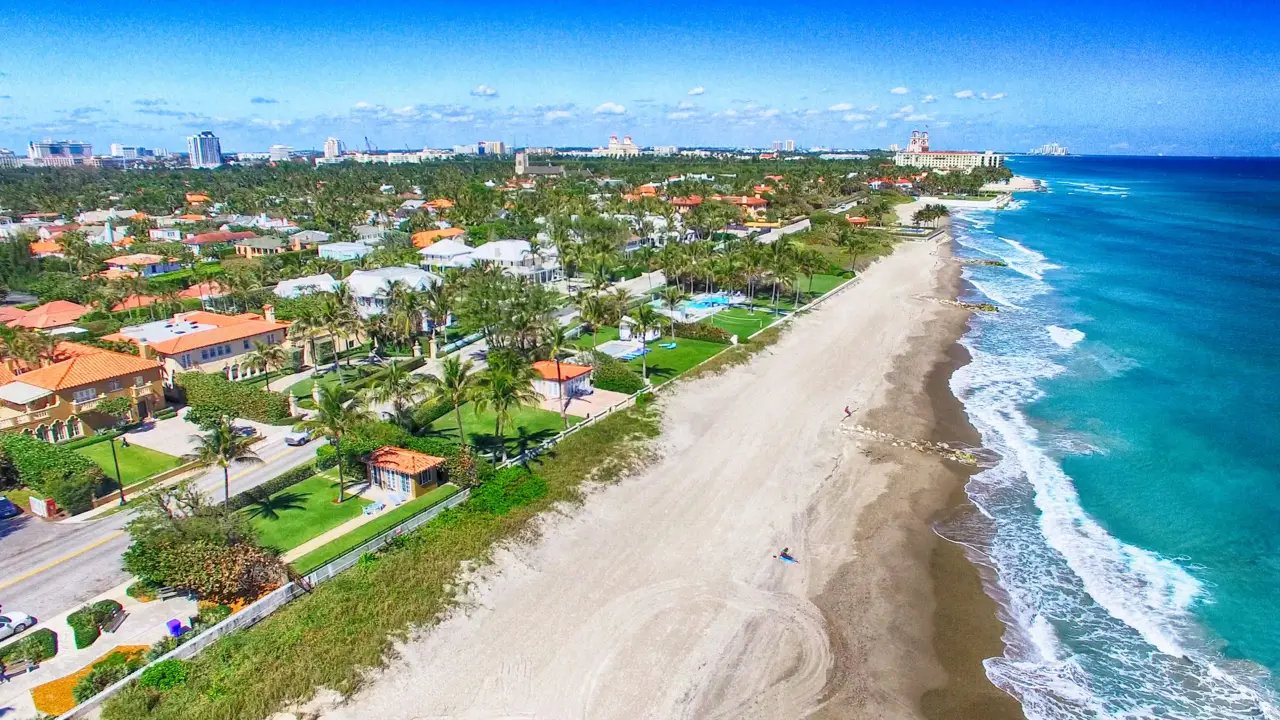
Where To Start Looking
This site has a page for each of the 18 cities I cover in the Palm Beaches, each showing homes for sale from our BeachesMLS feed. A few places to start: West Palm Beach, Palm Beach, Jupiter, Palm Beach Gardens, Delray Beach, Boca Raton and Boynton Beach.
If you are looking at 55+ communities, the 55+ homes search shows homes the feed marks as 55+.
This is not legal or tax advice. Check with a Florida attorney or tax professional.
If You Do Just One Thing
From the day you move, keep a simple calendar of where you are each day, and keep the receipts and records that back it up.
That one habit supports New York's time factor,18 and the Florida steps above give you the documents for homestead. Then file for homestead by March 1.
Frequently Asked Questions
Do I Have To Give Up My New York Driver License?
Yes, when you get a Florida license. The Palm Beach County Tax Collector notes that a Florida license requires surrendering your license from another state. Florida's homestead law also lists evidence that you gave up other states' licenses as a factor in deciding permanent residence.4
Is A Declaration Of Domicile Required For Homestead?
No. The Palm Beach County Property Appraiser lists it as "Declaration of Domicile, if applicable." It is one of several proofs. Others include a Florida vehicle registration, voter registration, federal tax return or utility bills. You still need a Florida driver license or ID card.2
Can I Keep My New York STAR Benefit And Get Florida Homestead?
No. Florida law bars homestead for anyone receiving or claiming a residency-based property tax exemption or credit in another state. The Property Appraiser names STAR and Enhanced STAR.19 New York's STAR page says to close the registration if you sell or no longer want the benefit.
Does New York Still Tax Rent From My New York Apartment?
Yes. As a nonresident, you still pay New York tax on New York source income, which includes income from real property located in New York State.5
Does Amendment 3 Apply If I Move To Florida In 2027?
Yes, under the new-resident rule. The amendment covers people who had not maintained a permanent residence in Florida as of 12-31-2026.25 They start with $25,000 off school taxes and $50,000 off other taxes, and get the full amount from their fifth year of exemption.25 The Legislature sets the procedures.
Want to see any of these homes? Call or text Deborah at (561) 889-7980.
Search West Palm Beach FL Homes Search Boca Raton FL Homes Search 55+ Homes In Palm Beach County FL
Sources
Official and primary sources. The small numbers in the article link here.
- Palm Beach County Property Appraiser, The Homestead Exemption (opens in a new tab)pbcpao.gov, checked 11-05-2026Back To Article
- Florida Statutes 196.015 (2026) (opens in a new tab)leg.state.fl.us, checked 11-05-2026Back To Article
- The Florida Senate, Florida Constitution (Art. VII, s. 4 and s. 5(a)) (opens in a new tab)flsenate.gov, checked 11-05-2026Back To Article
- Palm Beach County Tax Collector, home page (opens in a new tab)pbctax.gov, checked 11-05-2026Back To Article
- Palm Beach County Tax Collector, Exchange Out-Of-State Driver License/ID Card (opens in a new tab)pbctax.gov, checked 11-05-2026Back To Article
- Florida Department of Highway Safety and Motor Vehicles, What to Bring: U.S. Citizen (opens in a new tab)flhsmv.gov, checked 11-05-2026Back To Article
- Florida Department of Highway Safety and Motor Vehicles, Motor Vehicle Registrations (opens in a new tab)flhsmv.gov, checked 11-05-2026Back To Article
- Florida Statutes 320.38 (2026) (opens in a new tab)leg.state.fl.us, checked 11-05-2026Back To Article
- Palm Beach County Tax Collector, Motor Vehicle Registration (opens in a new tab)pbctax.gov, checked 11-05-2026Back To Article
- Palm Beach County Tax Collector, Motor Vehicle Titles (opens in a new tab)pbctax.gov, checked 11-05-2026Back To Article
- Florida Statutes 222.17 (2026) (opens in a new tab)leg.state.fl.us, checked 11-05-2026Back To Article
- Florida Statutes 196.031 (2026) (opens in a new tab)leg.state.fl.us, checked 11-05-2026Back To Article
- Florida Statutes 196.011(9) (2026) (opens in a new tab)leg.state.fl.us, checked 11-05-2026Back To Article
- Florida Statutes 194.011(1) (2026) (opens in a new tab)leg.state.fl.us, checked 11-05-2026Back To Article
- Florida Statutes 193.155 (2026) (opens in a new tab)leg.state.fl.us, checked 11-05-2026Back To Article
- Palm Beach County Property Appraiser, FAQ (opens in a new tab)pbcpao.gov, checked 11-05-2026Back To Article
- Florida Division of Elections, Constitutional Amendment No. 3 (2026 General Election), ballot title, summary and full text (opens in a new tab)flelectionfiles.floridados.gov, checked 11-05-2026Back To Article
- Florida Statutes 718.503(2) (2026) (opens in a new tab)leg.state.fl.us, checked 11-05-2026Back To Article
- Florida Statutes 719.103(12) (2026) (opens in a new tab)leg.state.fl.us, checked 11-05-2026Back To Article
- Florida Statutes 720.401(1)(a) (2026) (opens in a new tab)leg.state.fl.us, checked 11-05-2026Back To Article
- Florida Statutes 689.302 (2026) (opens in a new tab)leg.state.fl.us, checked 11-05-2026Back To Article